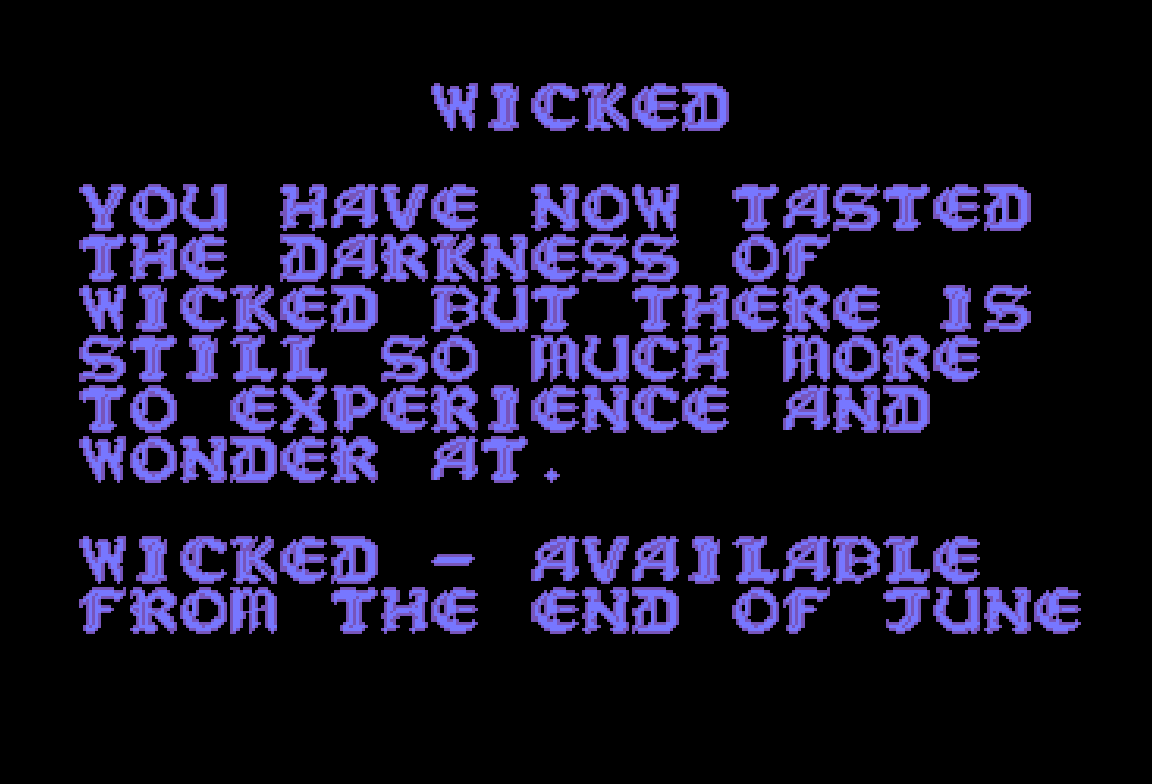
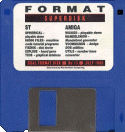
 Back in the middle of June 1989, the final issue of ST/Amiga Format had, as was usual for computer magazines of the time, a disk sellotaped to its cover. There was nothing immediately obvious, sitting amongst the other computer magazines in the rack in WH Smith, that this disk was going to be different to any other magazine coverdisk. But this disk contained a demo of a soon-to-be released game for the Amiga that from the first moment it loaded, left an indelible mark on a teenage pysche.
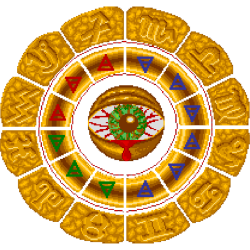
 Perhaps it was the originality of the game at a time when the market was flooded with side scrolling shooter derivatives, the tarot and astrological themed graphics, or the atmospheric music that made me shift in my seat and take notice. This game demanded your attention. It has certainly remained in my consciousness for the past thirty-plus years.
That game is Wicked.
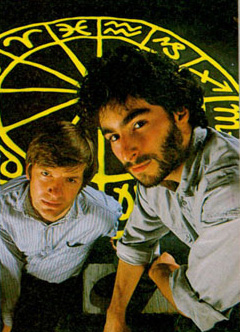 A tactical arcade game, designed and written by Paul Norris and Rupert Bowater of Binary Vision, Wicked was published through Electric Dreams/Activision and released on 28th June 1989 for the Amiga, Atari ST and later, the Commodore 64. Wicked was Binary Vision’s first 16-bit computer game, having previously been 8-bit developers writing ‘Zoids’ and ‘Stifflip & Co’ for the ZX Spectrum and Commodore 64.
According to the review of Wicked in ‘The One’ Magazine issue 10 (p60), Paul Norris was responsible for Wicked’s concept and design. “The idea came from a pendant I was given as a present. The pendant had the face of the sun in the centre and this sparked off the idea of doing something in a mythological vein.”
I needed to play more than just the one level the demo offered. Finishing the demo promised “so much more to experience and wonder at“, and certainly did not include the Eye of Infinity, or the more occult elements that the full game contained. In retrospect, perhaps the enticement of something deemed illicit to a teenager helped cement it into my subconscious further.
It took a long time to save up £25 – and given that was (controversially) £5 more than the Atari ST version because of it’s “enhanced graphics (identical) and music (absolutely)” – longer than it would have if I didn’t own an Amiga. I had just the demo with the single level on a well-worn coverdisk to play to tide me over for those long months, along with the Players Guide in ‘The One’ Magazine Issue 11 to pour over and regular visits to pick up and hold the box in the town’s computer store. But eventually I had enough to buy it. 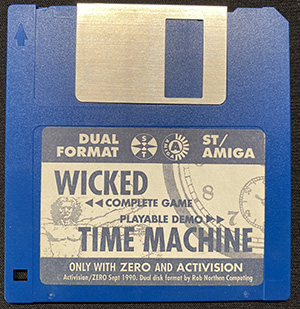 It was later given away on the September 1990 coverdisk of Zero magazine issue 11.
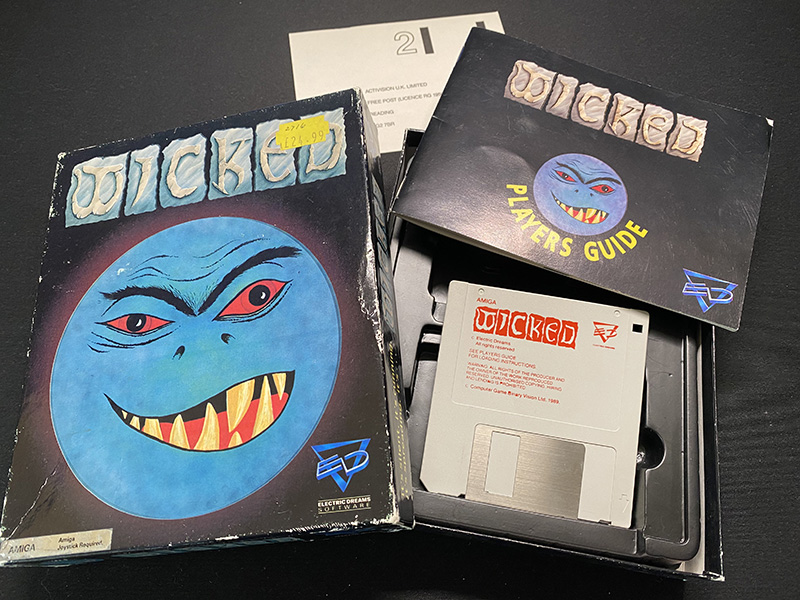
I still have my original boxed Amiga game to this day (and the Zero coverdisk), surviving university and many house moves.
It is a game that can still evoke visceral reactions even now. Whilst watching me play one evening, an animation of a (literal) central character just after I had lost all my lives and right before the game over screen appeared made my wife involuntarily shout, “WHAT THE HELL WAS THAT?” More bewilderment followed, and then that piece of music starts up.
It is a game that requires that investment of assiduity. Searching on YouTube, you can find long play videos, such as the one by Zeusdaz – who is also clearly a huge fan given the number of videos he has made about it – along with many other YouTubers (Paul Denning’s playthrough with the ending is here), you find that comments are split between people who clearly still have fond memories of – and love – the game, those who haven’t seen it before but still find it impressive today, and those who had absolutely no idea what was going on. It is also ridiculously hard, and almost impossible to finish without cheating.
I am fascinated to learn more about the game, understand it’s algorithms to play it better, and document it for posterity. Preserving this information is as important for the continued scholarship of our gaming history as would other historical artifacts, to prevent such jewels from being forgotten altogether. Wicked may look simple on the outside, but buried within is such a clever game design and that’s what makes this an excellent game – one that is easy to pick up and play and provide an increasing level of challenge. So, in that child-like method of experimentation and discovery, it involves ripping it apart to see how it works. I present what I have found, but without the source code, most of what is here is opinion and speculation. Neither is it going to be complete – this dive into what makes Wicked work is probably going to be a perpetual work-in-progress.
 The Eye Of Infinity