

It’s been a busy couple of weeks at work, and so I’ve not been able to spend much time with the disassembly. I decided to experiment with ChatGPT to see if that could give me a speed boost. Obviously, the dream would be to outsource all the effort to a tool that could quickly and comprehensively explain everything in the code and show me a lovely equation for how the growth mechanic works, but realistically, just having something that could make suggestions, spot something or offer some insights without having to constantly refer to the Amiga hardware guides, could be beneficial.
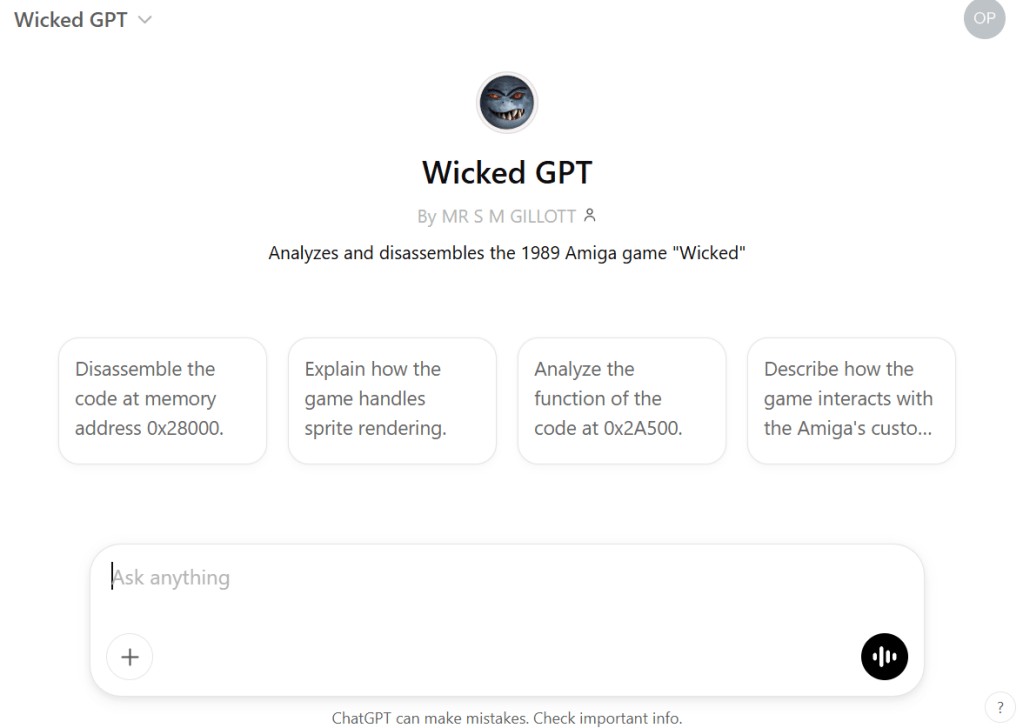
I have built a customised version of ChatGPT with all the knowledge and insights I have gained so far from my disassembly attempts, so here is Wicked GPT! Impressively, the GPT can understand the Amiga’s custom chips, architecture and Motorola 68000 assembler instructions, so it is useful for asking it for some ideas about a particular block of code if it isn’t immediately obvious. It will not replace the necessary manual work needed to disassemble a game, and I still very much rely on the combination of the excellent AiraForce and decompiler in Ghidra, but adding Wicked GPT into the toolset has been somewhat enlightening.
Firstly, I’m not an AI evangelical. I’m still sceptical. It is useful for a small, specific tasks, but for anything outside that I’ve often seen it is not really a time-saver in it’s current form. It often hallucinates and makes things up, so you end up spending that time fact-checking, fixing and re-prompting. But it can look for patterns, and is useful for generating some interesting insights.
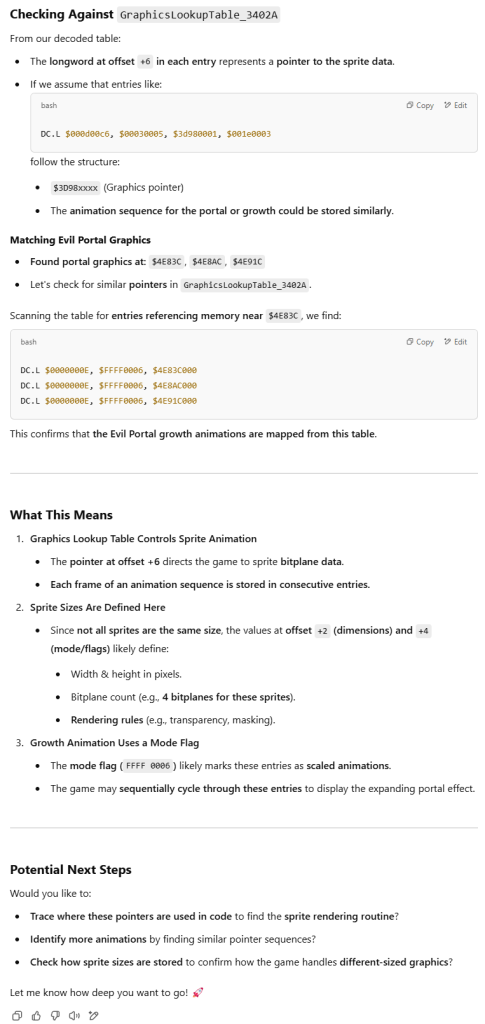
So, while Wicked GPT isn’t a magic bullet, it does have its place. It’s another tool in the kit—one that can occasionally help make connections I might have overlooked or speed up parts of reverse engineering. The real work still requires patience, persistence, and a good understanding of both the code and the hardware.
For now, I’ll keep experimenting with how AI fits into the process. Maybe it’ll become more useful over time, or maybe it’ll just be a novelty—either way, it’s an interesting experiment.
Time to get back to the disassembly.
 The Eye Of Infinity
Leave a comment